
Copyright remains with Goutham Ramesh. Please do not reuse this photograph without permission.
“True divinity needs no display of power. Even in the fiercest moment of victory, there can be an extraordinary sense of grace.”
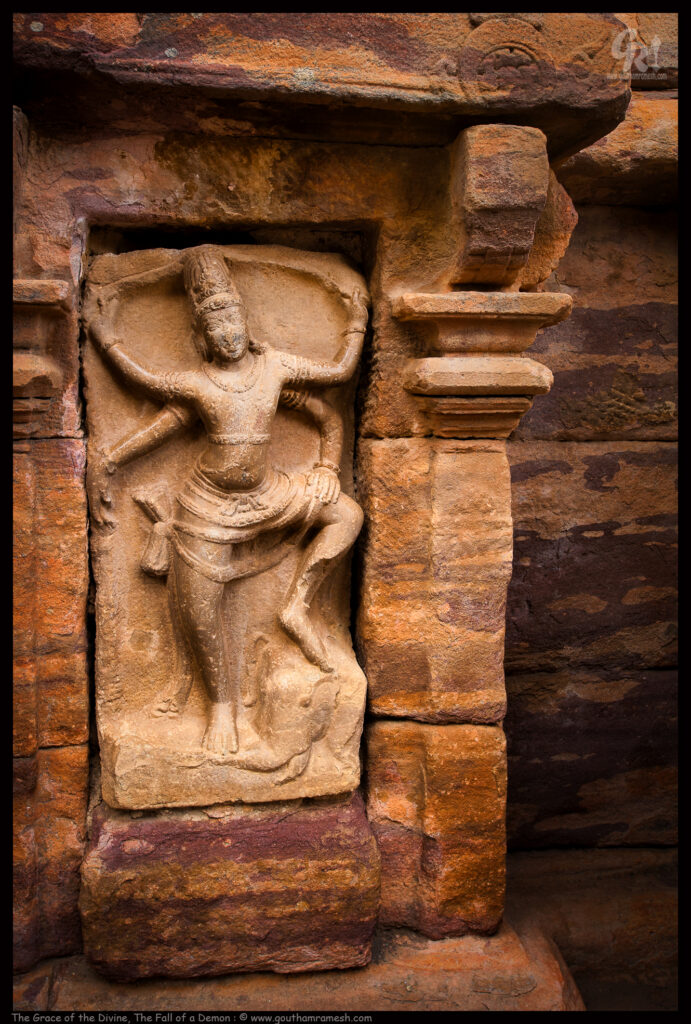
At the magnificent Virupaksha Temple in Pattadakal, built in the 8th century CE, the Chalukyan sculptors portrayed Lord Shiva as Gajasamharamurti, the destroyer of Gajasura, the demon who assumed the form of an elephant.
The sculpture captures Shiva standing with one foot resting upon the head of the defeated elephant demon, while his upper arms stretch upwards, holding the elephant’s hide in a graceful arch above him. It is a powerful depiction of divine triumph, yet what fascinated me most was the remarkable simplicity of Shiva’s form.
Despite the ferocity of the episode, there is an effortless elegance in his posture. No exaggerated aggression, no overwhelming display of strength, just a calm, graceful figure whose very presence conveys absolute power. Standing before this sculpture, I could not help but admire how the Chalukyan artist balanced such a dramatic mythological moment with extraordinary restraint. For me, the beauty of this masterpiece lies in that contrast, the destruction of evil expressed through the quiet simplicity and grace of the divine.
Comments are for approved members
Public previews can be shared for marketing, while community discussion stays inside CPA.
Log In